The State of New Orleans Nonprofit Operations H2 2026
A field report from Crewgood · New Orleans, July 2026
After navigating the uncertainty of the city budget, national economy, and new faces at City Hall through 2025, nonprofit leaders have seen some answers and even more questions in 2026. We sat down with 21 local nonprofit leaders to hear what changed, what still needs to, and what the organizations weathering it best are doing differently. This is the full report.
In this report
Foreword
After navigating the uncertainty of the city budget, national economy, and new faces at city hall through 2025, nonprofit leaders have seen some answers and even more questions in 2026. Now, as we head into the second half of 2026, nonprofits around New Orleans are asking, what's next?
We sat down with local nonprofit leaders — executive directors, comms leads, program staff — to talk about what has changed, what needs to change, and what they're doing to grow their service to reach more New Orleanians.
What surprised us wasn't that nonprofits are stretched thin. It was how similar the stretching looked across 21 very different missions.
This isn't a statistical survey. 21 organizations don't make a census of New Orleans nonprofits, and we don't pretend otherwise. What 21 conversations do give you is pattern — the kind of pattern that shows up when seven different EDs describe the same problem in seven different ways. Suddenly it's not their problem anymore. It's THE problem. Where we had to reach for a number beyond our interviews, we pulled from public sources and labeled them clearly. You'll always know which is which.
If you're running a nonprofit in New Orleans — or working next to someone who is — we hope you find that you're not alone in your struggles, and we hope you find useful tips and strategies to help you focus on your mission with less admin burnout.
To the 21 leaders who sat down with us: thank you. You gave us time you did not have, and we are truly grateful for that.
— Kevin O'Sullivan, Director of Marketing, Crewgood · New Orleans, July 2026
New Orleans nonprofits by the numbers
Two things are true about New Orleans nonprofits. One, local funding can't backfill what federal cuts are taking. Two, most of the daily pain leaders feel isn't about money at all. This section sizes both.
The local funding picture
$37.3B in total revenue across Louisiana's 20,200 reporting nonprofits — hospitals, universities, and community groups combined.
$513M in direct federal grants to Louisiana nonprofits in FY 2024 — and the real flow is larger. Much of it routes through state agencies that aren't counted as "nonprofit" in federal data.
$39.5M moved from the Greater New Orleans Foundation to 623 nonprofits in 2024.
$15.6M moved from Baptist Community Ministries, the region's second-largest place-based funder, in FY 2024.
GNOF and Baptist Community Ministries — the two largest place-based funders in Greater New Orleans — moved about $55M between them last year. The federal and municipal cuts in play outweigh that: a single home-repair nonprofit losing $2 million in DOE funding, the city clawing back $14.7 million in ARPA dollars from community programming, and more. Local philanthropy is a backstop. It's not a sufficient one.
Where the pain actually shows up
If money alone can't fix what's being cut, the question becomes what can be changed about how nonprofits operate. So we asked. Of the 21 New Orleans-area nonprofit leaders we interviewed, 86% named administrative burden as a top pain point, 76% named tech and tools, 67% named communications, 67% named coordination, and 62% named community engagement.
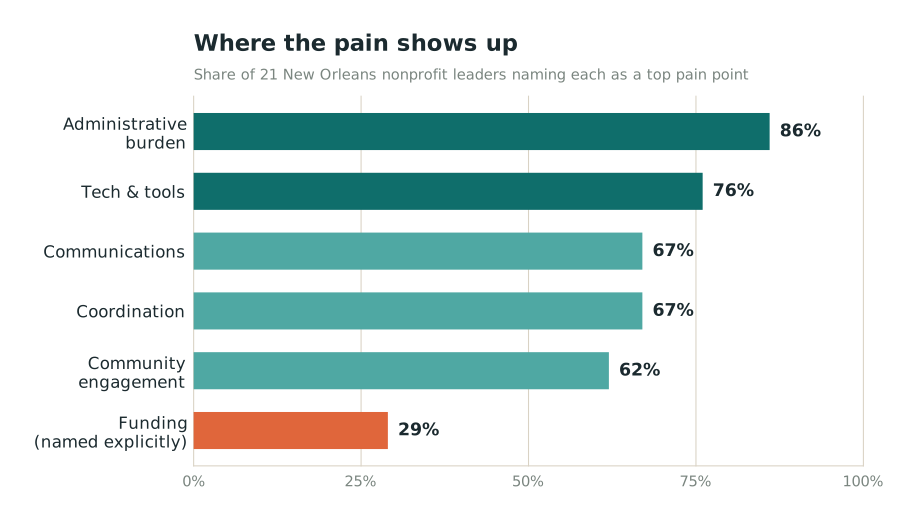
"Only 29% explicitly named funding itself as a top pain point — unusual for a nonprofit sample."
That number is likely a sampling artifact, not a sector truth. Leaders with time for a long interview are usually the ones who've stabilized — the orgs in active funding crisis aren't taking calls. The funding picture is bleaker than this number suggests.
We grouped what we heard around the patterns leaders named most, to map where the work breaks and what to do about it: The Admin Tax, Franken-Stacks, The Comms Team of One, The Referral Black Hole, The Funding Cliff, What the Less-Burdened Do Differently, and What Crewgood Is Building in 2026.
Chapter 1 — The Admin Tax
86% of the leaders we interviewed named admin burden as their top pain point.
An ED at a New Orleans home-repair nonprofit told us, in February, that her staff was just getting to calls from last December.
In the abstract, "admin burden" sounds like filing taxes and processing payroll. It isn't. What leaders described is the work that accumulates between the organization and the mission it exists to serve — explaining, documenting, reminding, following up, re-entering, routing, confirming, chasing. The work that, with the right tools and processes, looks like nothing. Without them, it becomes a more-than-full-time job.
She walked us through the bottleneck — not the 30 to 50 intake calls a day, not eligibility review, but what happens after a person has been deemed eligible: following up, explaining how to send the documents, walking a 72-year-old through finding her Social Security card. The mission-critical admin that doesn't show up in anyone's impact report.
"50% of my time goes to admin and fundraising, not program work."
— ED at a NOLA youth-arts nonprofit
Systems amplify it, not reduce it
It scales with systems, not staff. At a mental-health-services nonprofit large enough to need program teams, the ED still takes crisis calls personally — there is no HR department. The tools that should reduce admin burden often add to it instead. The sole staffer at a housing-services nonprofit spends five hours every month re-entering contacts, by hand, into a CRM that has no bulk upload. A youth-sports nonprofit's impact data lives with an outside consultant who built the dashboard. The org can't update it without him.
The grant cycle resets every year
Most interviewees who rely meaningfully on grants described an annual reset. A grant ends; a new grant begins; the reporting for the old one overlaps the compliance start of the new one. There is no carryover of institutional memory from the funder side; each new RFP is a new set of requirements to learn. The work begins again from scratch, every fiscal year.
Why it persists
Two structural reasons keep this in place. First, admin scatters across roles — most organizations distribute admin functions across leadership and program staff rather than holding them in a dedicated team. Second, no middle-tier tool exists — the integrated tools that would meaningfully reduce admin burden do not exist in one place at a price point the sector can afford.
The hours that go to admin are the hours that don't go to mission. Every leader we interviewed started a nonprofit to do a specific kind of good. None of them started one to spend 20 hours a week chasing documents.
15–25 hours/week per leader, on admin. At one nonprofit, the ED spends 15–20; the co-founder, 20–25. Imagine giving them that time back.
Free from Crewgood: an answers search bar for your website. Your team answers the same handful of questions dozens of times a week. Add a search bar in one line of code and it handles the repeats — drawn only from your own content. Get your free search bar →
Chapter 2 — Franken-Stacks
"30+ systems for 35 people."
— The development team at a NOLA youth-mentorship nonprofit
A founder bought one tool to solve one problem. A grant required a different tool. A consultant recommended a third. The first board chair had a relationship with a vendor. Someone's niece built a custom dashboard in 2019 and then moved to Austin. What results is what we started calling, during these interviews, a franken-stack: a working-ish assembly of tools, bolted together at the seams, often with human transcription filling the gaps. Expensive, fragile, indispensable.
76% of NOLA leaders named tech and tools as a top pain point — the second most common complaint in our sample.
The regression. Not every franken-stack grows — some shrink. A death-and-dying support nonprofit told us they had dropped their relational database outright because the price didn't pencil, and they now track donors and clients on spreadsheets. A staff member described "significant time" spent relaying the same information repeatedly to different people who would benefit from self-service, if self-service existed. When the franken-stack gets unaffordable, organizations don't consolidate. They fall back to the spreadsheet.
45% of nonprofits surveyed nationally by NTEN in 2024 said they are not spending enough on technology.
How a franken-stack shows up in practice
At a South Louisiana home-repair nonprofit, a single piece of client information moves like this: an email confirms eligibility, the email goes into the CRM, the CRM data gets re-keyed into a spreadsheet. Three systems. Two human handoffs. One chance per handoff to miss a detail. Multiply by thousands of applicants.
At a workforce-development nonprofit, getting one learner from intake to certification involves benchmarking in one system, enrollment across three different platforms (one per credential track), coordinating test dates with contacts at 25 schools, pulling scores from a fourth system, generating certificates in a fifth, then re-entering everything in a different format for grant reporting. An organization with multiple program teams runs this choreography on Google Sheets.
"Because we don't build the dashboard, we're not really self-reliant when it exists."
— The ED at a NOLA youth-sports nonprofit
The tool lives outside the organization even when the data inside it describes the organization. Public transparency — part of the mission — becomes contingent on the consultant's availability.
Why it persists
It's not incompetence, and we didn't meet a single leader who was proud of their stack. Three constraints keep the franken-stack in place. Compliance widens it — any organization touching clinical services, minors, or regulated data (HIPAA, FERPA, certain HUD requirements) cannot legally consolidate everything into one system. Funders widen it further — grant reporting platforms are rarely interoperable with the CRMs nonprofits actually use; five grants often equals five partially parallel databases. And cost narrows what can replace it — integrated platforms that could absorb six smaller tools are priced for enterprise buyers.
The missing middle
Enterprise platforms cost too much for the sector. Cheap or free tools get abandoned when nonprofits don't grow into bigger contracts. There's no middle tier. NOLA nonprofits we spoke with carry a monthly software bill for tools the staff broadly describes as underused. Put next to the NTEN finding that most nonprofits say they are not spending enough on tech, the picture sharpens. They are not underspending. They are under-integrating.
Chapter 3 — The Comms Team of One
67% of NOLA leaders we interviewed named communications as a top pain point.
At a neighborhood-scale environmental-justice organization we interviewed, one person handles all communications, outreach, research, design, and community engagement. She is also the executive director. She is also the programs lead. When we asked how she manages, she paused: "I have to manage the projects. All day, every day."
She is not a rare case. She is the norm. In nearly every conversation where comms came up as a pain point, the second thing out of the leader's mouth was a variation of: there is no one whose job this actually is.
Comms staffing doesn't scale with size
We asked every interviewee who, specifically, owns external communications:
| Organization size | Typical comms staffing |
|---|---|
| Under 5 staff | One person — usually the ED — handles everything. Sometimes shared with a board member running social part-time. |
| 5 to 20 staff | Still one person. Sometimes the ED; sometimes a "development and communications" hybrid whose other half is fundraising. |
| 20+ staff | Still one person, or comms as a "shared responsibility" with no single owner. Rare exceptions have one dedicated comms director, who serves the entire org alone. |
Not a single organization we interviewed had what most businesses would call a communications team. The numbers don't change meaningfully with budget. An organization can grow to 50 staff, or 80, or 100, and comms is still, functionally, one person.
What it looks like in practice
The website goes stale. At a visual-arts training nonprofit with two administrative staff, Instagram had quietly become the most up-to-date public-facing surface the organization had — the website was more than 20 years old. The platform that demands the least friction wins, even when it's the wrong tool for the job.
The bottleneck is one person. At a roughly 100-person animal-welfare nonprofit, all external communications flow through a single marketing manager — who is also the website gatekeeper. When she took a week and a half of vacation, every website update queued behind her return.
Engagement is invisible. The founder and ED of a youth-sports organization with about 18 staff told us, with the matter-of-fact honesty we heard often: "I have no idea what the engagement is on that. I'm not that savvy." The social feeds are alive. The newsletter goes out. Nobody is watching.
Even the exception serves alone. A few organizations did have a named, dedicated communications role — one person, not zero. The ED of a mental-health-services organization described their comms director and data team as actual peers with a clear handoff structure, and called it out, unprompted, as something the organization had invested in deliberately. But it is still one person, spread across teen audiences, clinical constituencies, funders, donors, and media. The gap between zero and one is enormous. The gap between one and two is, at the organizations we interviewed, almost never crossed.
"People don't know we exist until they're already in crisis and down the wrong path."
— The ED at a NOLA death-and-dying support nonprofit
Why nobody hires the second one
Hiring a second comms person — or a first, at the orgs that have none — requires money that is routinely not in the grant. Funders who want sharper communications out of a grantee will rarely pay for the role that would produce them. At organizations without a dedicated comms role, the staffer who would own communications is also the staffer who would process intake, file reports, and take crisis calls. There isn't a second body to absorb the work, and there isn't budget to hire one. So the work either falls on the one person, or it doesn't happen.
Your website can answer even when your one comms person can't. A free Crewgood answers search bar surfaces what you've already published the moment someone asks — no new content, no new hire, one line of code. Add it to your site →
Chapter 4 — The Referral Black Hole
"People in crisis call 10+ places and get bounced."
— The ED at a NOLA nonprofit serving the unhoused community
Someone in New Orleans picks up the phone on a Tuesday afternoon. They need help — with a utility bill, a piece of paperwork, a place to sleep, a program for their kid. They call a nonprofit they heard about from a neighbor. The nonprofit doesn't offer that service, but suggests another nonprofit. They call that one. The number has been disconnected. They call 211. The agency 211 points them to has lost its funding, but nobody has told 211. They call a fourth. A fifth. By the sixth call, business hours are over.
67% of NOLA leaders named community engagement or coordination as a top pain point. In our interviews, the two problems kept collapsing into each other.
Nobody owns the truth about which services exist in New Orleans right now, where they operate, or who they still serve. Services change locations, hours, or lose funding. Partner organizations send people to each other for help those partners no longer offer. The 211 directory is helpful in theory and often outdated in practice. At a death-and-dying support nonprofit, the ED told us she regularly spends real time looking for community resources on behalf of the families her organization serves, only to reach a dead phone number or a program that quietly ended six months ago. A grieving family's crisis is how the organization learns the data has gone bad.
None of this is anyone's fault in isolation. Every individual organization is doing its best to maintain its own public information. The information that would need to be kept current belongs to nobody, so nobody keeps it current.
How referrals actually break
Discovery fails too. A two-person public-safety nonprofit told us that people Googling "New Orleans Police" land on the nonprofit instead of the police department. They arrive expecting services the nonprofit does not offer. During our interview, the two leaders couldn't locate their own contact email on their own website. The search engine has decided their URL is the right answer to a question they cannot answer.
Even correct referrals die. Sometimes the information is right — the referrer knows where to send someone, the receiver is the right organization. The handoff still fails. Staff at a homeless-services nonprofit told us that some partner organizations simply do not return calls or emails. A correctly routed referral dies silently. There is no automated follow-up, no notification that the warm handoff didn't land. The sending org assumes the problem was solved. The receiving org never knew there was a problem to solve. The person in the middle is gone.
People become the infrastructure. A paid staffer who runs operations for a handful of volunteer-led neighborhood associations described her role, essentially, as the unofficial switchboard of her block — knowing which program is at which address, who pays sliding scale, whose phone to try first when a resident shows up not knowing where to start. That is heroic. It is also fragile. A single person's institutional memory is not a system.
What's missing
When we asked interviewees what would help most, the answers were strikingly similar across very different organizations. The leadership of a public-safety nonprofit described the criminal-justice data landscape as "impressive but so disparate" — technically available, practically unusable. One of them said it quietly: "I've always wished for a comprehensive survey list of who's doing what, where, when, and how well are they doing it." The data exists. The organizations exist. The people asking for help exist. What is missing is the part of the civic infrastructure that tells any New Orleanian, in under ten seconds:
Yes, that service is running, here, right now, and they answer their phones.
Chapter 5 — The Funding Cliff
"$0 from state and city next year."
— ED at a NOLA arts nonprofit
The executive director of a long-running New Orleans arts nonprofit told us, calmly, that the next year would bring zero from state and city. He said it the way one describes a weather forecast — a fact about the environment, not a complaint. His organization was in the middle of a thousand small continuities that week: a refrigerator purchase, insurance paperwork, a new season's marketing. The floor he was standing on was moving, and he knew it.
The funding cliff didn't arrive as a single event. It arrived as a series of smaller cuts across federal, state, and municipal funding — each manageable on its own, each cumulatively less so when stacked.
1 in 3 community-serving nonprofits nationally lost government funding in the first half of 2025. Among those affected, government funding accounted for 42% of revenue on average.
In early 2025, the Urban Institute surveyed 2,737 nonprofits across the United States: 21% had lost a grant or contract outright, 27% faced delays or freezes, 6% received stop-work orders, and 29% had reduced staff by mid-year.
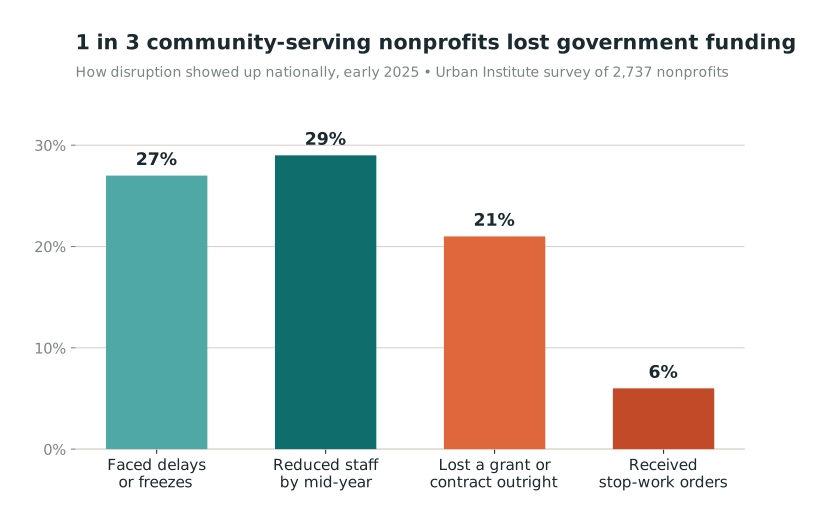
That is the national backdrop against which New Orleans' specific story unfolded. Nothing that happened here is unusual. What is unusual is the compression — the speed at which federal, state, and municipal cuts arrived inside the same 18-month window.
The federal layer
Serve Louisiana, a statewide AmeriCorps program, lost roughly $700,000 in federal grant funding in 2025 — funding that supported stipends for 37 service members placed across 18 Louisiana nonprofits. The cut was reversed in part by a federal district court, which granted a preliminary injunction after Serve Louisiana sued in May 2025. An injunction is a pause in a fight, not its resolution.
One NOLA home-repair nonprofit lost roughly $2 million in Department of Energy funding and a five-person AmeriCorps team in the same budget cycle, both tied to federal executive-order reshuffling. The ED summarized the math in one line: "Loss of federal funding — private funding isn't keeping up." When a $2M federal line disappears, the local philanthropic ecosystem cannot absorb the shift at the same scale.
HUD technical-assistance capacity collapsed across the four-state Louisiana, Mississippi, Alabama, and Arkansas service region. Technical-assistance grants pay for the consultants who help nonprofits without dedicated grants staff navigate federal bureaucracy, data systems, and compliance. When the scaffolding goes, the dollars remain legally available but become practically unreachable.
The municipal layer
$14.7M in unspent ARPA dollars clawed back by the City of New Orleans and reallocated to city operations.
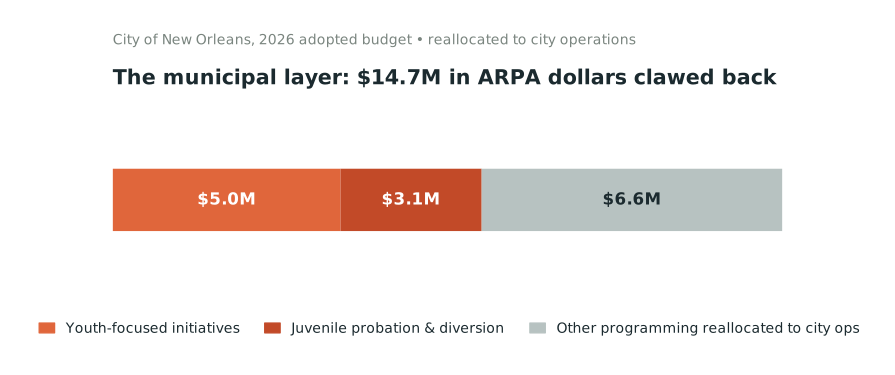
The clawback included more than $5 million pulled from youth-focused initiatives, and roughly $3.1 million pulled from juvenile probation and diversion programs. ARPA was, in technical terms, always one-time pass-through funding. In practical terms, it had been the only local infrastructure investment of its scale since Hurricane Katrina. When it disappeared, the programs it had backstopped did not have an obvious alternative source to pivot to.
In the same budget, a youth nonprofit named in the city's adopted budget documents lost approximately $70,000 in municipal support — about one-third of that organization's annual operating budget. For a NOLA nonprofit, a $70K cut is not a budget adjustment. It is a program ending.
An animal-welfare nonprofit we interviewed described the municipal cliff through a different line item: the city reduced its animal-control services contract by roughly 30% in 2025. That contract had represented a significant portion of the organization's revenue, and the shortfall shifted overnight onto fundraising and clinic earned revenue.
The city was managing its own cliff. The 2026 adopted budget closed a projected $222 million deficit through approximately $150 million in departmental cuts and furloughs affecting roughly 14% of the city workforce. The city itself was drowning. The nonprofits the city had asked to hold parts of its mission could no longer count on the city to hold its end.
The state layer
A century-plus-old performing-arts nonprofit described losing 10% of its budget overnight when the state's live-performance tax credit was allowed to expire. That ED listed, from memory, four peer institutions — an opera, a symphony, a historic music venue, and a theater — facing the same cliff simultaneously. For the New Orleans arts sector, the cliff was a category event.
The same pattern showed up across categories. At a mental-health nonprofit, roughly one-third of revenue came from HUD housing contracts described as providing inadequate overhead; unrestricted dollars were the rarest currency, and the ED put it directly: "If I don't have a budget for it, it really doesn't matter." At a death-and-dying support nonprofit, prior city council funding had "dried up with budget issues." At a public-safety nonprofit, fundraising had become the highest priority, specifically to backfill police-training funds the city had previously co-funded.
In every category we asked about — arts, housing, animal services, mental health, public safety, advocacy, family support — organizations described the same pattern: a municipal or federal funder that had been part of their revenue mix for years had reduced, delayed, or canceled its commitment inside the last 12 months.
The structural shape of the cliff
"When our fiscal year restarts, we sort of restart at zero."
— ED at a NOLA youth-sports nonprofit
The cliff is annualized. Very few of our interviewees have meaningful multi-year funding commitments. Each July, the paperwork resets. There is no mechanism for forward carry of institutional memory from the funder side. When federal and municipal support contract simultaneously, every organization working annually into the reset faces the cliff fresh.
Applying for what remains is more expensive. A leader at one arts nonprofit described grant writing as a "keyword guessing game" — funders deploying automated scanning for terms that applicants are never told are the terms. The HUD technical-assistance capacity that used to walk organizations through federal applications has disappeared from the state. The cliff is not only the size of the funding that remains. It is the rising cost of competing for it.
Private philanthropy can't absorb this. Every organization we interviewed described planning, in early 2026, for a fundraising environment sharper than the one they had budgeted for six months earlier. Most described cutting program scope quietly. A few described delaying hires they had been waiting years to make. Most leaders are running their organizations on short runway with long-held discipline and a lot of overtime. What separates the organizations weathering this more cleanly from the ones that are not is not, primarily, about money.
Fewer fires, same team. A free Crewgood answers search bar deflects the repetitive questions eating your week, so scarcer hours go to the mission. One line of code, nothing replaced. Start free →
Chapter 6 — What the Less-Burdened Do Differently
"AI curious and AI cautious."
— The leadership team at a NOLA workforce-development nonprofit
In every interview, at some point, we asked a version of the same question: is your organization handling this better than it was a year ago, or worse? Most answers were some form of "about the same, which is to say not well enough." A few were not. The organizations in the second group did not describe having more money or a secret tool. They described a handful of operational choices — unglamorous, mostly invisible from outside — that added up to an organization running with fewer fires per week. Five patterns came through.
Five patterns for fewer fires
Asked where they hoped to go next, several interviewees described the same shape: systems that track impact in real time rather than assembling it annually from spreadsheets; referral tracking that does not require a human to stitch it together; and digital access points where people actually look for help. They were not asking for magic. They were asking for what most functioning for-profit businesses already have — and assuming, rightly or wrongly, that the sector was quietly building it for them.
What we're building at Crewgood tries to meet that assumption. Whatever your organization adopts, or doesn't, these five principles are yours to keep.
Chapter 7 — What Crewgood Is Building in 2026
Underneath the patterns this report describes is a single problem. Your team is the only thing standing between someone who needs help and ten unread PDFs. Admin keeps pulling people away from the mission they came to do. The neighbors who need your work can't find you. The supporters who would show up have no easy way to find you either. Funders are scanning applications for terms nobody told you to use. And every July, the relationships you have built across three years start from a blank page.
The gap is not effort or intention. It is access, visibility, and the tools to bridge them both. Crewgood is one platform built to do that work — to take care of the admin so your team can focus on mission, get answers to the people who need them, reach the people who want to help, and connect you with the funders and partners who share your cause. Connected civic infrastructure for New Orleans. Public infrastructure for cooperation, not competition.
More questions answered. Less work for your team.
The 2026 benchmark. In every interview we did, a version of the same thing came up. Staff fielding the same handful of questions forty times a week. One person handling the website, the newsletter, the social posts, and the phones — alone. People in crisis calling ten organizations before someone picks up. The information was usually there somewhere — in a PDF, a newsletter, a social post nobody bookmarked. It just wasn't connected to the moment someone needed it.
The Crewgood solution. A chat widget or search bar on your existing website. One line of code, nothing replaced. When a community member asks something your organization has already answered, the answer surfaces instantly — drawn only from your own content. When the question is one you have not answered yet, you see exactly what is missing. When someone needs help your organization doesn't offer, they are routed automatically to a partner organization that does — a real warm handoff, not a phone tree.
Reach the people who need you — and the ones who want to help.
The 2026 benchmark. Your community is bigger than who is currently in it. A public-safety nonprofit whose website is the third Google result for "New Orleans Police" instead of the police department's actual page. A leader telling us, plainly, that people don't find them until they are already in crisis and down the wrong path. A two-person team that couldn't locate their own contact email on their own website. The neighbors, volunteers, and supporters who would show up if they could find you — most of them never make it through.
What we're building. One place for New Orleanians to follow the nonprofits they care about, see what is happening in their neighborhood, and get help when they need it. A live feed of mission updates. A community calendar. A real resource index. The organization-side tools feed it. The community side draws from it.
Connect with the funders who already share your cause.
The 2026 benchmark. The funder-discovery work most organizations do is what we heard, interview after interview. Open a tab. Search a keyword. Ask a board member. Hope something lands in front of someone who gets it. Applications scanned by algorithms looking for terms applicants were never told are the terms. Every July, the paperwork reset — relationships built across three years starting from a blank page when a new fiscal year began.
What we're building. Map the relationships your organization already has — board members, partner orgs, foundations, past donors, sponsors — into a visual tree, so you can see who you are already connected to and who you are one warm introduction away from. Keep every funder, donor, and supporter relationship in one place, with conversations logged and history intact, so July does not restart at zero. And speak the language funders are actually scanning for, so the mission gets seen for what it is, not filtered out at the first automated pass.
What stays true across everything we build
The core tools are free. No per-seat pricing. No feature gates on the things that actually matter.
Nothing is replaced. One line of code on your existing website. Your CMS, your CRM, your content — all of it stays.
Your content stays yours. You decide what goes in, and you can see where every answer came from.
Let's get to work
Crewgood is a small, passionate team building the platform we wish nonprofits already had. We are dedicated to helping the leaders of New Orleans nonprofits make a real difference in this city — by taking the admin off your team's plate, getting faster answers to your community, reaching the people who need you, and connecting you with the funders who already share your cause.
If you lead a New Orleans nonprofit and want to talk about your work, we want to hear from you. Twenty minutes. We will show you what we have built, learn what you are up against, and figure out together what fits.
Get started: crewgood.com/studio/get-started · Write to us: kevin@crewgood.com
Methodology & sources
Methodology
Between late 2025 and early 2026, we conducted 21 semi-structured interviews with executive directors, operations leaders, communications staff, and founders at New Orleans-area nonprofits. 19 are based in Orleans Parish, 1 in Jefferson Parish, and 1 outside Louisiana (excluded from NOLA-specific claims). Approximately 80% of interviewees were reached through warm introduction or referral — a sample that tends to over-represent organizations with stable margins and higher tech readiness, and to under-represent organizations in acute survival mode. Interview-derived findings should be read as patterns within our sample, not as statistically representative claims. No organization or individual is named in the body of this report; quotes are stripped of uniquely identifying details.
Public-data sources cited
All URLs accessed April 23–28, 2026.
How to cite
Crewgood. The State of New Orleans Nonprofit Operations 2026. Crewgood, 2026. crewgood.com/studio/field-notes/report-state-of-new-orleans-nonprofits-2026
Contact
If you lead a New Orleans nonprofit — or are a reporter, researcher, or funder interested in our methodology — and want to push back, correct something we got wrong, or tell us something we missed: kevin@crewgood.com.